From the moment I found out I was pregnant I knew I had a leg up on other moms when it came to labor and birth. As a former labor and delivery nurse, I’ve seen it all: the good, the bad, and the ugly. My time spent working on the busiest l&d unit in the country had exposed me to so many different types of women, labors, deliveries, work environments. I am so grateful for my time spent in labor and delivery. You could say it was a double edged sword having seen it all. I knew what to anticipate scientifically and medically which was reassuring but also terrifying.
I also had the absolute privilege of working for the practice I delivered Blair with. My midwives and OB’s were my friends which was the biggest blessing. I was constantly communicating with them, whether they wanted to hear from me or not.
I knew from the beginning what type of labor and birth I would ideally like to have but being a nurse I knew things could change in and instant, and boy did they.
On October 9th, my due date, I went into to my OB office to have Dilapan inserted. Dilapan is a mechanical dilator that can be used in the comfort of your home for the early latent stage of labor. The goal is to start dilation of your cervix in the comfort of your home instead of the hospital. Either you have the rods removed 24 hours later or you go into labor on your own.
I returned to the office 24 hours later, had the rods removed, and was 2-3cm dilated. I was sent to the hospital for an induction. I knew this could mean a lot of things, if there’s one thing I know about labor specifically inductions, is that they are unpredictable.
We were lucky and fortunate enough to have a former colleague and friend be our nurse for the almost two days I was in labor. By the time I left the office I was texting her and letting her know we were heading in, and my midwife and OB’s were calling the providers on call.
From the beginning I wanted to have as much autonomy as possible when it came to my labor and birth, which is what the midwife on call gave me. She knew I worked for the practice, was a labor and delivery nurse, and we discussed each option for further induction at length before making a decision. Ultimately I decided to start with Pitocin since I was a good candidate for it. Pitocin is like bringing out the “big guns” in labor and induction and it was my goal to have this baby as quickly and as safely as possible (this was my hope lol).
After about 12 hours on Pitocin I decided it was time for an epidural. I’ve seen hundreds of epidurals placed so I knew the process for the procedure. It truly helped me relax and gave me almost instant relief. I also had almost no pain while pushing and repair, just intense pressure but we’ll get to that later. After my epidural was placed, Foley catheter was in, and I got comfy my midwife came to check to see if I had made any progress. Unfortunately I was still 3-4/80/-3, which meant that I wasn’t advancing into the next stage of labor like I should be.
Blair looked perfectly happy on the monitor this whole time and I was having consistent contractions, but they weren’t dilating my cervix. We discussed AROM (artificial rupture of membranes), which I had wanted to be the absolute last thing done to induce labor. At this point I was sleep deprived and wanted to do what was best to advance my labor which was clearly going to be AROM…. This is where things quickly took a turn.
My midwife broke my water around 4am on October 11th, 2023, Blair wasn’t born until 6pm that night. It was a long journey within these next 14 hours where I constantly wrestled with my own decisions about my labor.
Shortly after AROM, Blair’s heart rate started to drop with each contraction. I was optimistic thinking that this might be a sign of head compression with early decelerations. This typically means baby’s head is engaging into the birth canal and could potentially mean imminent delivery. I have seen countless AROM’s where moms go from 3 to 8-9 within an hour. I was hopeful this would be my case. But it unfortunately was not.
The what looked to be early decelerations quickly turned into late decelerations, when baby’s heart rate drops after the peak of a contraction. This typically means that blood flow to the baby has been decreased from the placenta, most likely from umbilical cord compression. My nurse did all the correct protocols, switching my position, increasing IV fluids and the lates were looking more like variable decelerations but with every single contraction. By this time the midwife had already been called and was on her way to see me, and I was starting to become increasingly concerned.
When my water was broken we took away Blair’s comfy little home and she did not like it at all. Most likely a piece of the umbilical cord was being compressed by her head with each contraction, therefore decreasing blood flow to her. This would all be reassuring if I was progressing in labor but at this point I was only about 6/90/-3, still no where close to delivery.
She decided to insert an FSE (fetal scalp electrode) on Blair’s head to more accurately monitor her heart rate as well as an IUPC (intrauterine pressure catheter) to accurately measure my contractions. An amnioinfusion was also started, which circulated fluid back into the uterus to help alleviate pressure put on the umbilical cord.
Fortunately Blair responded great to the amnioinfusion but the thought of a cesarean section was fresh on my mind. If my body wasn’t processing in labor I knew this was a very real option. My husband, nurse, and midwife were all very comforting in assuring me we would exhaust all options to have a vaginal delivery.
My nurse was absolutely fantastic and she was doing everything she could to ensure a safe vaginal delivery. We constantly switched positions to help aid in my cervical dilation and engage Blair into my pelvis.
Around 3pm, a midwife that I worked with in the office came in on call and I knew everything was meant to happen for a reason. She came and checked my cervix and I was finally dilated 8-9. Around 5pm after laboring down for about an hour we started pushing.
When pushing began Blair did great, I was still on Pitocin which was making my contractions occur about 2 minutes apart. Quickly after we started pushing Blair’s heart rate would drop significantly with each push. We decided to cut off the Pitocin, which spaced out my contractions. They went from being about every 2 minutes to 4-5 minutes apart. This made pushing last about an hour, which was very exhausting. Everyone in the delivery room was so encouraging and supportive. They could all see I was getting very tired, but they never stopped encouraging me. I was never in any pain while pushing or delivery but I did feel intense pressure. It was more so uncomfortable than painful.
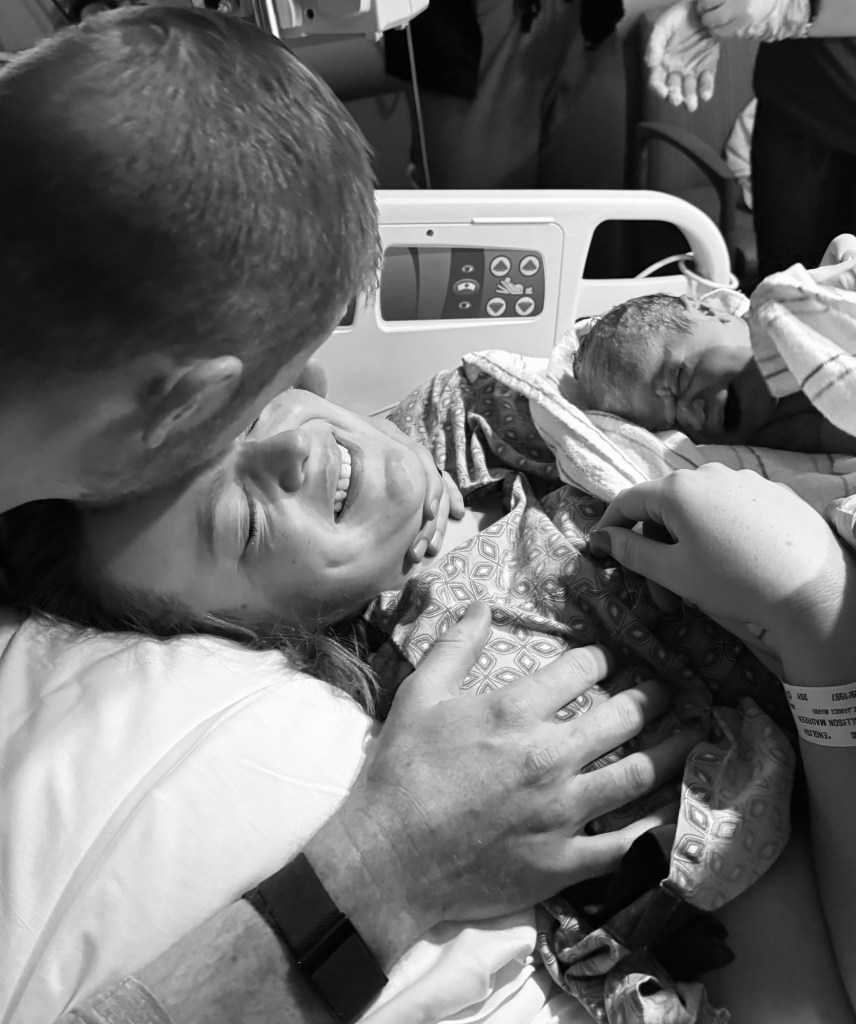
At 6:04pm on October 11th, 2023 out Blair Maureen Bearden was born. Weighing 7lbs 7oz and 20.5in long, she was our perfect little angel. I don’t think my labor and birth would be the same if I hadn’t had the providers I had while in the hospital. My nurse was absolutely amazing and it was perfect having a friend and colleague deliver my baby. I couldn’t have asked for a better experience.
That being said, I know a lot of interventions that occurred during my labor are foreign to most mothers and can be an added stress during labor when uninformed or unfamiliar. It is so important to be comfortable asking questions and doing research and taking classes prior to labor and birth.
Being in a comfortable environment is imperative and far too many women are afraid of asking questions or don’t know where to begin when it comes to educating themselves on pregnancy, labor, and birth.
I hope to encourage expecting moms, moms to be, and women to speak up when it comes to their healthcare and don’t be afraid to ask questions and educate yourself. Access to healthcare can be difficult for some so I hope to be an educational tool for young moms and create an open forum to discuss all things pregnancy and baby, free from judgement.
 Allison Bearden, RN
Leave a comment